Strung Up Under the Eaves: A Week With the Persimmons Japan Leaves Out for the Wind
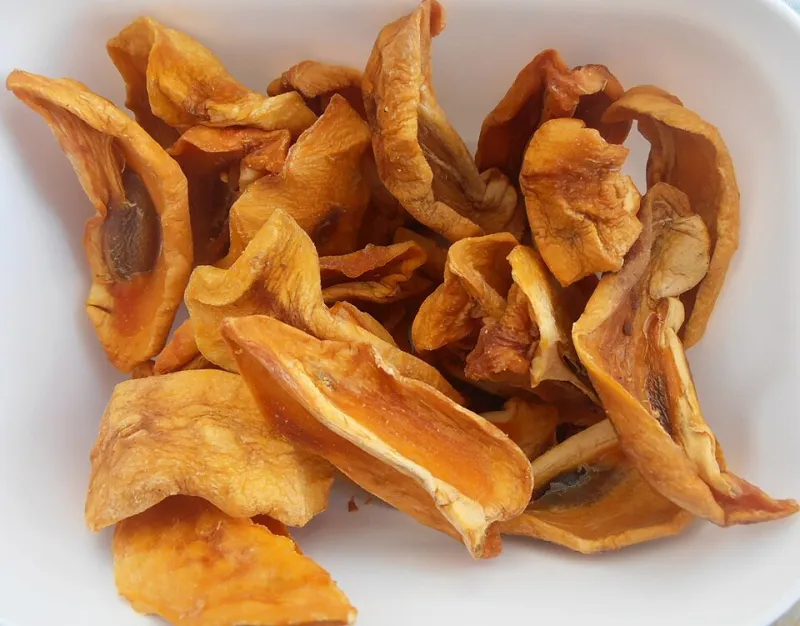
Photo: sarang, Public domain, via Wikimedia Commons
The first thing you notice isn't the color. It's the smell — faintly sweet, faintly like a wooden cupboard that once held fruit.
The Morita family's house sits at the end of a lane in a village in the Nagano hills, and by the second week of November the entire southern face of it has gone orange. Forty strings, maybe fifty. Each one carrying a dozen peeled persimmons, hung from a bamboo pole under the eaves like a curtain somebody forgot to close.
Why Anyone Bothers
A fresh hachiya persimmon is a trap. Bite into one before it's ripe and your mouth turns inside out — the tannins are so astringent they feel like a mistake you made with your whole face.
And yet. Hang that same fruit in cold moving air for three or four weeks and something alchemical happens. The tannins break down. The flesh collapses into something dense and honeyed, with a texture somewhere between a dried fig and a really good date. Sugar blooms white on the surface like frost. In Japan it's called hoshigaki, and it has been made this way for centuries, in the same weather, with the same technique, by people who never once wrote down a temperature.
Peeling, Tying, Hanging
Mrs. Morita starts at six in the morning, because the work is better in the cold. The persimmons have been picked slightly underripe and left to sit a day. She holds each one against a small hand-cranked peeler and turns it, taking the skin off in one long ribbon without breaking the calyx at the top — that little green star is the anchor, and if you lose it, the fruit can't hang.
Then a string, looped around the stem, tied with a knot her hands do without looking.
Her husband does the hanging. He climbs a short ladder, hooks the strings onto the bamboo, spaces them a hand-width apart so the air can move between them. The whole job takes the better part of two days.
Then Comes the Massage
About a week in, the fruit starts to soften and wrinkle, and the second job begins: yogomi. Once every few days, someone stands at the pole and gently kneads each persimmon between their palms — not squeezing, not crushing, just encouraging the inside to break down evenly instead of hardening in the middle.
It is tedious. It is sticky. The Moritas do it while talking about the neighbors.
Skip the massage and you get a leathery shell around a hard core. Do it and you get that custardy, translucent center that people in this village describe, without irony, as the whole point.
The Weather Is in Charge
Hoshigaki is a food that can only be made in a place with cold, dry, sunny autumns and a reliable breeze. Rain is the enemy — a wet week means mold, and mold means the whole string comes down.
Which is why the Moritas watch the forecast the way Americans watch a playoff game. When a storm is coming, they carry the poles inside or cover them with plastic. When the wind picks up and the air goes sharp and clear, they leave everything out and don't worry.
They've both mentioned, separately, that the season starts a little later than it used to. Warm Octobers push everything back. The persimmons don't care about anyone's schedule.
What It Actually Tastes Like
Around the first week of December, Mrs. Morita cuts one down, wipes off the sugar bloom, and hands it over with a cup of bitter green tea.
It is not like candy. It's denser than that, more savory at the edges, with a slight chew and a long finish. The sweetness builds instead of hitting. You eat it in three bites and then sit there for a second, because your mouth is recalibrating what a persimmon is allowed to be.
How to See the Season Without Being a Problem
Go in late November or early December. That's the window. Before that, the eaves are empty. After that, everything's been taken down and packed away.
Look up, not in. The strings hang on the outside of houses, which means you can see them from the road without entering anyone's property. That is the entire point of the design. Enjoy it from the lane.
Ask before you photograph the house. You wouldn't want a stranger framing your porch from the sidewalk with a zoom lens. Same deal here.
Book a workshop instead of improvising. Several regional tourism associations and farm-stay programs run hoshigaki sessions in November — peeling, tying, and taking home a string of your own to finish. Ask at the local michi no eki or the town's tourism desk; that's how these things are actually found, not through a booking site.
Buy direct. Farm stands, roadside station shops, and JA co-op counters sell hoshigaki in small boxes from late November. Buy a box. That's you participating in the economy of the thing, which is worth more than a hundred photos.
Don't offer to help. If someone wants you to peel, they'll ask. Rural Japan is extremely polite and extremely particular about how things are done, and a well-meaning visitor with a peeler is a liability more often than a gift.
Skip the supermarket version and expect to pay for the real thing. A proper box of hand-massaged hoshigaki costs real money. It should. Somebody stood in the cold kneading fruit for a month.
The Point of the Whole Exercise
There is no machine for this. There's no shortcut, no freeze-dryer equivalent, no industrial workaround that produces the same result. Hoshigaki exists because a family decided that a fruit too harsh to eat fresh was worth four weeks of attention.
Come in late autumn and you'll see, hanging on the south side of a lot of old houses, the physical evidence of that decision. It's one of the few Japanese traditions that hasn't been moved indoors for the tourists. It's still just a family, a pole, and the weather doing most of the work.