Getting Paid to Show Up: The Americans Finding Purpose — and a Paycheck — as Rural Japan's Community Anchors
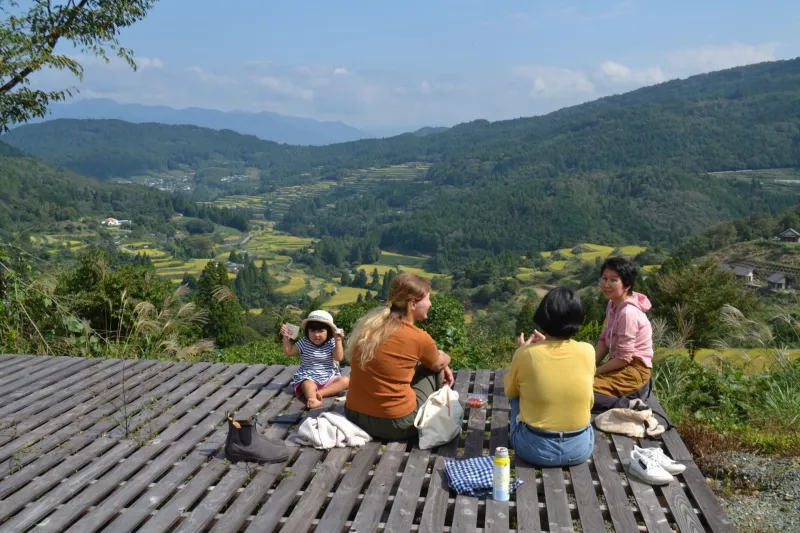
Photo: elderly Japanese villagers and young foreigner sharing meal in rural countryside community center, via blogs.ucl.ac.uk
There's a word in Japanese — kodawari — that roughly translates to an obsessive devotion to doing something the right way. It's the philosophy behind a sushi chef who trains for a decade before touching a fish, or a ceramicist who fires the same bowl shape for forty years. What nobody expected was that some rural Japanese towns would apply that same obsessive care to the art of simply having neighbors.
And yet, here we are.
Across Japan's countryside, a quiet but striking experiment is unfolding. Towns that have watched their populations shrink for decades — schools closing, storefronts going dark, festivals dying for lack of participants — are trying something unconventional. They're hiring foreigners, many of them Americans, not as English teachers or tech workers, but as what you might loosely call professional community members. The job description, if you can call it that, is essentially this: show up, connect, and help a place remember what it felt like to be alive.
The Numbers Behind the Loneliness
To understand why this is happening, you have to sit with some uncomfortable statistics. Japan is aging faster than almost any other country on earth. By some estimates, over 10 million homes across the country stand vacant — entire neighborhoods of dark windows and overgrown gardens. In the most affected rural prefectures, the over-65 population makes up more than 40 percent of residents. The young have moved to Tokyo, Osaka, and Nagoya, chasing jobs and convenience and the particular electricity of city life.
What gets left behind isn't just empty buildings. It's the social infrastructure that holds a community together — the casual conversations at the rice paddy's edge, the shared meals after a shrine festival, the simple comfort of knowing your neighbor's name. Researchers have started calling this kizuna decay: the slow erosion of the human bonds that make a place feel like home rather than just a location.
Some municipalities have responded with financial incentives, subsidized housing, and remote-work programs aimed at luring back urban Japanese. But a smaller, more experimental cohort of towns has looked outward — specifically, toward foreigners who might bring fresh energy and, crucially, no preconceived notions about what a Japanese community is supposed to look like.
What the Work Actually Looks Like
Ask Marcus, a 34-year-old from Portland who's been living in a small town in Shimane Prefecture for two years, and he'll laugh before he answers. "My official title translates to something like 'regional vitalization coordinator,' but honestly, most days I'm just having lunch with people."
His mornings often start at a community center where elderly residents gather for light exercise and conversation. His Japanese is functional but far from fluent, and somehow that limitation has become an asset. "When I get something wrong or ask a dumb question, people light up to explain things to me. It creates this opening. They're not just tolerating a conversation — they're actually in one."
That dynamic — the foreigner as a kind of social catalyst — comes up again and again when you talk to Americans in these roles. There's something about the outsider's genuine curiosity that cuts through the social reserve that can sometimes calcify in tight-knit, aging communities. You're not carrying the weight of decades of local history and hierarchy. You're just a person who wants to know why the persimmons are hung to dry that particular way, or what the old name of the mountain was before the maps changed.
For Danielle, a 29-year-old from Atlanta now based in a coastal town in Tottori, the work has taken on a distinctly archival quality. "A lot of what I do is just listening," she says. "These residents have incredible knowledge — folk remedies, fishing techniques, songs that haven't been written down anywhere. If nobody's around to hear those stories, they disappear with the person."
Her town has started a small oral history project, and Danielle finds herself at the center of it — not as an expert, but as an enthusiastic audience of one, which turns out to be exactly what's needed.
The Cultural Negotiation No One Warns You About
This isn't a frictionless arrangement, and anyone who tells you otherwise is selling something. Japan has a famously complex relationship with outsiders, and rural Japan especially carries a deep attachment to the idea that community is something you're born into, not something you volunteer for.
There's a concept called uchi-soto — the distinction between inside and outside, between those who belong and those who are guests. Foreigners, almost by definition, start on the outside. Breaking through that boundary takes time, consistency, and a willingness to be uncomfortable.
"There were months where I felt completely invisible," Marcus admits. "I'd show up to events, help clean up, bring food — and still feel like I was watching through a window. Then one day an older man asked me to help him repair his fence, and something shifted. We didn't even talk much. But after that, people started treating me differently."
That shift — from visitor to someone who has done something together with the community — is the hinge point that nearly every American in these roles describes. Japanese rural culture is built on shared labor and shared ritual. The moment you stop being a spectator and start being a participant, the calculus changes.
Is It Sustainable — Or Just a Feel-Good Story?
Skeptics raise fair questions. Can a handful of foreign residents genuinely reverse demographic decline? Isn't there something uncomfortable about the idea of a town essentially purchasing human connection? And what happens when the Americans go home?
Those are worth sitting with. The towns themselves seem aware of the limits. Most frame these programs not as solutions but as bridge strategies — ways to keep communities functional and emotionally viable while longer-term revitalization efforts take hold. A town that has lost 30 percent of its population in a decade isn't going to recover because a few Americans joined the neighborhood association. But a town that has given up — where the last social bonds have snapped and the remaining residents have retreated into isolation — is much harder to revive.
In that framing, the presence of community builders is less about fixing a problem and more about keeping a flame lit until conditions improve.
And for the Americans themselves, the question of sustainability is deeply personal. Some stay for a year and leave with a changed sense of what community can mean. Others, like Danielle, find themselves renegotiating their entire understanding of home. "I used to think belonging somewhere meant being from there," she says. "Now I think it might just mean choosing to stay."
The Hometown That Adopts You Back
There's a beautiful symmetry in what these towns are attempting, even if it's imperfect and provisional. Japan's concept of furusato — the hometown, the place your heart returns to — has always carried a note of longing, of something precious and slightly out of reach. For millions of Japanese who've left their rural roots behind, furusato is a feeling more than a place.
For the Americans who've landed in these shrinking towns and decided to stay, something unexpected is happening. They're building a furusato of their own — not inherited, but chosen. Not rooted in ancestry, but grown from shared mornings and repaired fences and stories heard over green tea in a drafty community center.
It's a strange and quietly radical thing. And in a country that has long defined belonging by bloodline and birthplace, it might just be pointing toward something new.