Inheriting Someone Else's Ancestors: The Americans Who Became Keepers of Japan's Oldest Inns
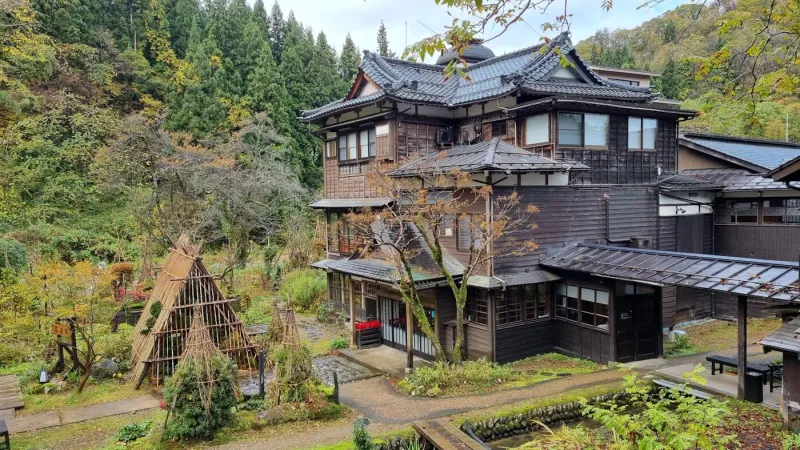
Photo: American expat traditional Japanese ryokan inn mountain village, via japanko-official.com
Somewhere in the mountains of Nagano Prefecture, a woman from Portland, Oregon is folding yukata robes at five in the morning. The inn she runs has been in operation since the mid-1700s. She is not related to the family that built it. She learned to fold those robes from the last surviving daughter of the founding line, who was in her eighties and had no one else to pass the knowledge to.
This is not a unique story anymore — though it still sounds like one.
Across rural Japan, a slow-moving but remarkable phenomenon has been gaining momentum: Western expats, many of them American, are taking over the stewardship of traditional establishments that might otherwise vanish. Ryokans. Sake breweries. Minshuku guesthouses tucked into fishing villages. Tea ceremony spaces. The reasons these places end up in foreign hands are complicated, and the cultural weight of what these newcomers are carrying is enormous.
Why These Places Are Available in the First Place
Japan's rural depopulation crisis isn't news to anyone who's been paying attention. Hundreds of towns across the country are watching their populations age out, with younger generations migrating to Tokyo, Osaka, and other urban centers for work and opportunity. When the last family member of a three-century-old ryokan decides they can't — or won't — continue the business, the choices are grim: sell to a developer, let it fall apart, or find someone willing to take it on.
That's where people like Marcus, a former restaurant manager from Seattle, entered the picture. He'd been living in Japan for six years, teaching English in Gifu Prefecture, when a local community development organization approached him about a struggling minshuku whose elderly owner had recently passed. The building was structurally sound. The reputation was solid. What it lacked was a future.
"I thought they were joking," Marcus says. "Then I realized they were absolutely not joking, and also that I had maybe three weeks to decide."
He said yes. That was four years ago. He now serves handmade soba to guests who book months in advance.
The Learning Curve Is Steep — and Personal
Taking over a traditional Japanese inn or brewery isn't like buying a franchise. There's no operations manual. The knowledge that makes these places special lives in the hands and habits of the people who ran them, and absorbing that knowledge requires something closer to apprenticeship than orientation.
For many American stewards, the first year is a crash course in humility. The rituals of a ryokan — the precise sequence of a kaiseki meal, the etiquette of the onsen, the way seasonal decorations shift the mood of an entryway — aren't written down anywhere accessible. They're observed, practiced, corrected, and practiced again.
Jennifer, who now runs a sake brewery in a small Tohoku town with her Japanese-American husband, describes the learning process as "trying to read a book that's written in a language you're still learning, about a subject that has no direct equivalent in your own culture." Her mentor, the brewery's former toji (master brewer), spent two years working alongside her before he felt comfortable stepping back. He still stops by occasionally to taste the current batch.
"He never says it's good," she laughs. "He says it's 'not bad.' I've decided that's his version of a standing ovation."
Authenticity vs. Accessibility: A Constant Negotiation
One of the thorniest questions these expat stewards face is how much to adapt their establishments for international guests without diluting what makes them worth visiting in the first place. It's a balance that requires constant recalibration.
Some guests — particularly those coming from the US — arrive with expectations shaped by luxury travel content and Instagram aesthetics. They want the experience of a traditional inn, but they also want to understand what they're experiencing. That's where foreign stewards have an unexpected advantage: they remember what it felt like to encounter these traditions for the first time.
"I can explain things in a way that a Japanese innkeeper might not think to explain, because to them it's just obvious," says Marcus. "Why do we leave slippers outside the tatami room? Why is the bath schedule the way it is? I went through all of that confusion myself. I can meet guests where they are."
But that accessibility has limits. Most stewards are adamant about preserving the core experience — the quiet, the seasonality, the specific local foods, the unhurried pace — even when guests push back. "This isn't a theme park version of Japan," Jennifer says simply. "If someone wants a Western breakfast, I'm happy to point them toward the convenience store down the road."
What the Community Makes of It
Local reception to foreign stewards is — predictably — mixed, and often more nuanced than a simple thumbs-up or thumbs-down. Older residents sometimes express skepticism, not out of hostility, but out of genuine uncertainty about whether an outsider can truly understand what they're preserving. Younger locals, by contrast, are frequently enthusiastic, seeing these expats as proof that their hometown has value worth fighting for.
What tends to win over even the skeptics is time and sincerity. Showing up to the neighborhood cleanup. Learning the local dialect. Participating in the town's annual matsuri without making it a photo opportunity. These are the small acts that accumulate into something resembling trust.
Marcus describes the moment he felt genuinely accepted as the day an elderly neighbor left a bag of homegrown vegetables on his doorstep without a note. "In that town," he says, "that's the equivalent of a formal welcome ceremony."
A New Kind of Furusato
The Japanese word furusato — loosely translated as "hometown" or "place of origin" — carries a depth of emotional meaning that English struggles to capture. It implies belonging, memory, and a sense of being rooted in something larger than yourself. For most Japanese people, their furusato is inherited. For these American stewards, it's chosen.
There's something quietly radical about that. And there's something deeply in keeping with the spirit of these places — which have always survived by adapting, by finding new ways to remain relevant without losing what made them matter.
If you find yourself staying at a small inn in rural Japan and your host greets you with a slight American accent and a perfectly executed bow, don't be surprised. You might be in the presence of someone who has given up a lot to make sure that bow — and everything it represents — still exists for you to receive.