What's No Longer There: How Americans Are Learning to Listen to Rural Japan's Quiet
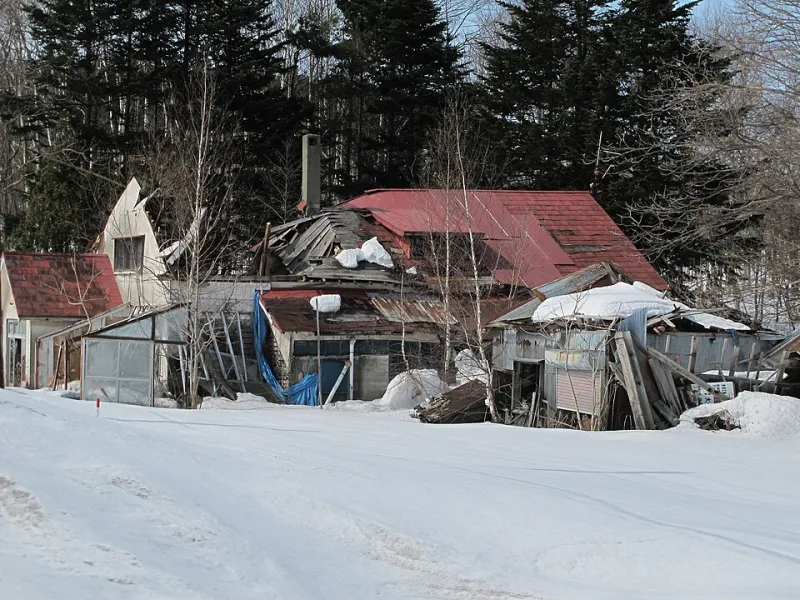
Photo: Sgroey, CC BY-SA 4.0, via Wikimedia Commons
Danielle Marsh spent her first month in Shimane Prefecture convinced something was wrong with her ears.
She'd moved from Columbus, Ohio — not exactly a metropolis, but a city with its own low-grade roar: traffic, lawn mowers, the hiss of a bus pulling away from a stop. In her new village of roughly 800 people, the silence felt so complete it almost had texture. She'd lie awake at night, straining to catch something familiar. What she found instead was the absence of things she hadn't even known she was listening for.
"It took me a while to figure out that the quiet wasn't just the absence of noise," she says. "It was the absence of specific sounds. And once I started noticing what was missing, I couldn't stop."
Danielle is part of a small but growing community of Americans who've relocated to rural Japan — through programs like the regional revitalization initiatives, artist residencies, or simply a leap of faith — and discovered that the countryside speaks most clearly in what it no longer says.
The Sounds a Town Keeps Even After They're Gone
Every community has an acoustic fingerprint. In Japan's rural areas, that fingerprint was shaped over generations: the clatter of children spilling out of a wooden schoolhouse, the rhythmic clang of a blacksmith's shop, the tinny melody of a pachinko parlor or a game arcade drifting down a covered shopping street on a Saturday afternoon. These weren't just sounds. They were evidence of life organized in a particular way.
Many of those sounds are gone now. Japan's rural depopulation crisis — driven by decades of migration to cities, an aging population, and declining birth rates — has left thousands of villages acoustically hollowed out. Schools have consolidated or closed entirely. Small manufacturers have shuttered. The covered shotengai shopping arcades that once anchored town centers sit half-empty or fully dark.
What remains is a kind of sonic negative space. And for people trained to look at a place rather than listen to it, learning to read that space is a skill that has to be developed deliberately.
Marcus Teel, a former high school history teacher from Vermont who now lives in a small community in Iwate Prefecture, describes the process as something like learning a new language — except the vocabulary is made entirely of gaps.
"I'd walk past the old elementary school and just feel this weight," he says. "The building was still there, the playground equipment was still there. But there were no kids. No noise. And once I learned the history — that the school had closed when the last family with children moved away — I couldn't walk past it without hearing that absence like it was a sound itself."
The Archaeology of Everyday Noise
In folkloristic terms, what Marcus and Danielle are describing is something close to what scholars call intangible cultural heritage — the living expressions of a community's identity that exist not in objects but in practices, sounds, and rhythms. When those expressions disappear, they leave traces that are harder to catalog than a broken pot or a crumbling wall.
But expats who've spent real time in rural Japan tend to become surprisingly fluent in those traces.
Take the bōsai musen — the village public address system. In most rural Japanese communities, a loudspeaker mounted on a pole still broadcasts daily announcements: the time, weather warnings, community notices. It's one of the most distinctly Japanese sounds imaginable, and in villages where it still functions, it anchors the day in a way that feels almost ceremonial.
In towns where the population has dropped too low to maintain it, the poles are still there. The speakers are still there. They just don't broadcast anymore.
"The first time I noticed a silent PA pole, I didn't even know what I was looking at," admits Keiko Hartwell, a graphic designer from Portland, Oregon who relocated to rural Hyogo Prefecture — the same region that gives Aioi Furusato its name — about four years ago. "Someone had to explain it to me. And then I started seeing them everywhere. These poles that used to organize people's days, just standing there."
For Keiko, that moment opened up a new way of reading the landscape entirely. She started photographing silent PA poles, abandoned festival storage sheds, shuttered candy shops with faded price lists still taped to the windows. Not as ruin porn, she's quick to clarify, but as a kind of documentary practice — an attempt to make the invisible audible.
"Every one of those things used to make a sound," she says. "The festival shed means there was a matsuri, and a matsuri means there were enough people to carry the mikoshi. The candy shop means there were enough kids to buy candy after school. When you look at it that way, you're not just seeing a closed building. You're hearing a crowd that isn't there anymore."
Learning to Sit With It
None of this is easy, emotionally speaking. Several Americans who've lived in rural Japan for extended periods describe a kind of grief that comes with developing this kind of acoustic literacy — a mourning for communities they never actually knew, for sounds they never personally heard.
But many also describe something that sits alongside the grief: a deep sense of connection to a place, precisely because they've learned to hear its losses.
"There's a Japanese concept I keep coming back to," says Marcus. "Mono no aware — this bittersweet awareness of impermanence, of things passing. I didn't really understand it intellectually until I started feeling it in these places. The silence teaches you something about how to hold loss without being destroyed by it."
Danielle puts it more practically. After nearly three years in Shimane, she says the silence she once found unsettling has become something she actively seeks out.
"I go back to the States and I'm overwhelmed," she laughs. "Not just by the noise, but by how much of it is just... filler. It doesn't mean anything. Out here, every sound means something. And the silences mean even more."
Why This Matters for Anyone Visiting Rural Japan
You don't have to move to rural Japan to start developing this kind of listening. Even a short visit to a countryside town — especially one that's been touched by depopulation — can shift the way you perceive a place if you approach it with the right kind of attention.
Slow down. Walk streets that aren't on any tourist map. Notice the closed storefronts, the empty lots, the playground equipment with no children on it. Ask a local what used to be there. If you're lucky enough to stay with a family through a minpaku homestay or a traditional inn, ask them what sounds they miss.
The answers will tell you more about Japan's hometown soul than any guidebook can.
Because the furusato — that deeply Japanese idea of a hometown you carry inside you, a place that shaped you whether you were born there or not — lives as much in what's been lost as in what remains. Learning to hear that loss is, in its own quiet way, one of the most profound forms of cultural understanding a traveler can develop.
And it starts, like most things worth knowing, with learning to be still.